
Building Blocks for Better AI Prompts
Whether you’re just starting to explore Claude or other AI chat tools, or you’ve been using them for a while and simply want to improve your prompting habits, the foundational lessons in Prompting 101 are a helpful reminder of what actually leads to better results.

Getting an AI model to produce exactly what you want on the first try can feel surprisingly difficult, especially during a busy workday when prompts often become rushed, instructions get a little vague, or we assume the AI understands more context than it actually does. The good news is that better prompting usually doesn’t require complicated techniques. Small improvements in clarity, structure, and context can make a huge difference in the quality of the response.
Great prompting isn’t about finding secret keywords or “magic” phrases. It’s about communicating clearly. The best prompts provide context, define goals, clarify priorities, and explain what a successful response should look like.
The Building Blocks of a Prompt
If the ideas in the video feel difficult to apply directly to your own prompting workflow, it can help to think about prompts as a set of flexible building blocks. There are eleven core sections you can use to add clarity, structure, and direction when needed. That said, not every prompt requires all eleven. Simple requests may only need a role and a clear objective, while more strategic or complex tasks benefit from additional context and guidance.
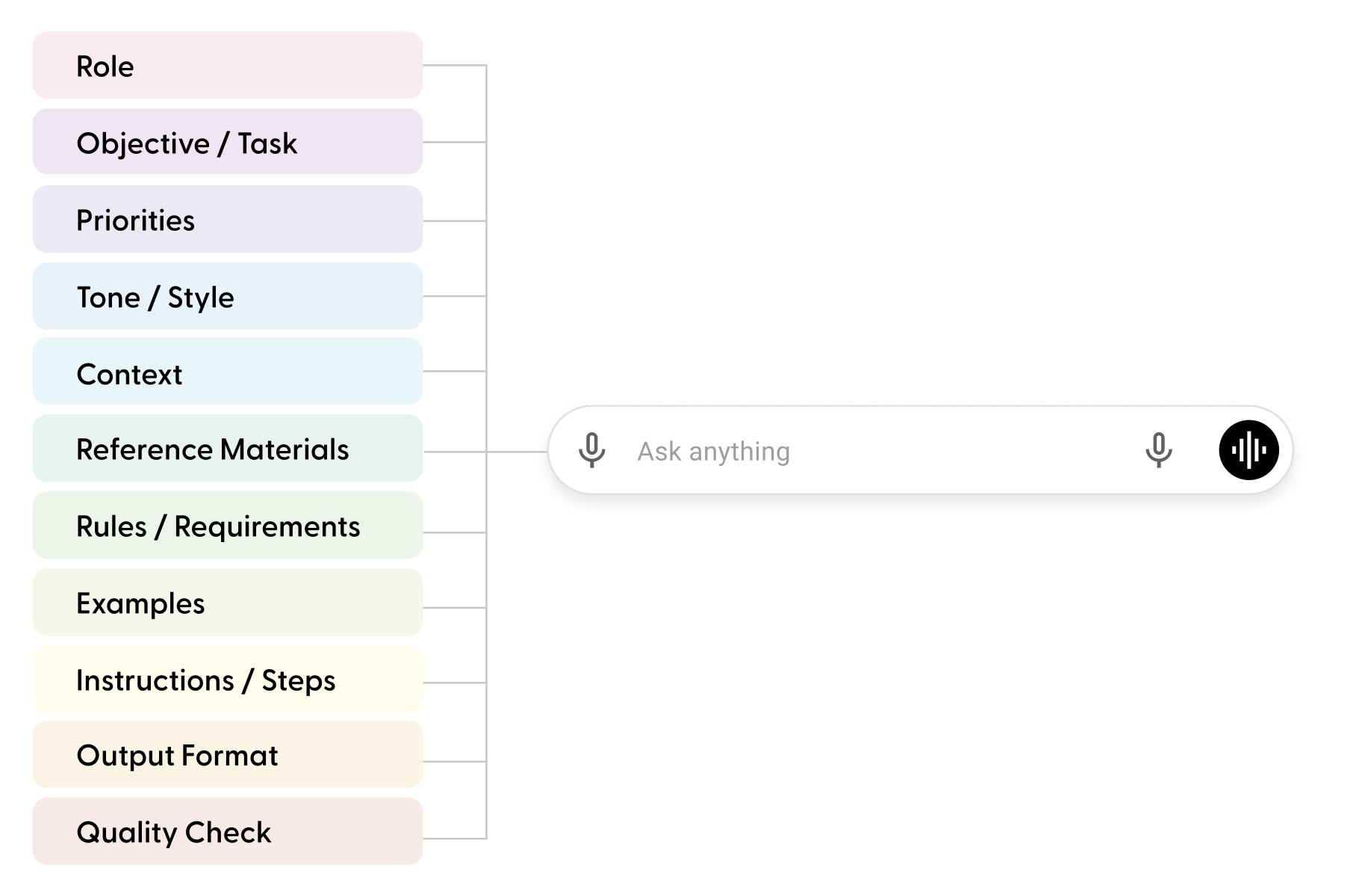
Role
Definition: Defines who the AI should act as, including its expertise, perspective, and level of experience.
Purpose: Defines expertise / persona
Why it matters: Improves tone, reasoning, and perspective
Example
You are a senior UX strategist and product designer with expertise in AI-powered SaaS platforms, onboarding experiences, and user adoption optimization.
Your role is to evaluate product experiences from both a business and user perspective, balancing usability, clarity, engagement, and conversion outcomes.
Objective / Task
Definition: Clearly explains what the AI needs to accomplish or produce.
Purpose: Defines success
Why it matters: Reduces ambiguity
Example
I want you to review and improve the onboarding experience for a new AI-powered website builder designed for small businesses.
Your task is to:
- identify friction points in the onboarding flow
- recommend UX improvements
- improve activation and first-value experience
- suggest messaging and guidance improvements
- propose ways to increase completion rates and product adoption
The goal is to create a smoother, faster, and more intuitive onboarding experience for non-technical SMB users.
Priorities
Definition: Establishes what matters most when making decisions or tradeoffs in the response.
Purpose: Determines how the AI should evaluate competing considerations
Why it matters: Improves alignment with the intended outcome
Example
Prioritize the following when making recommendations:
1. Simplicity and clarity for non-technical users
2. Faster time-to-value and activation
3. Reducing onboarding abandonment
4. Practical improvements that can realistically be implemented
5. Balancing user experience with business goals
If tradeoffs exist, prioritize usability and clarity over feature complexity.
Tone / Style
Definition: Specifies how the response should sound, feel, and communicate.
Purpose: Controls voice and presentation
Why it matters: Improves consistency and usability
Example
The response should feel:
- strategic
- thoughtful
- practical
- collaborative
- easy to understand
Avoid overly academic UX language or generic best-practice advice.
Write as though you are presenting recommendations to:
- product managers
- designers
- executives
- engineers
Context
Definition: Provides background information, business details, goals, audience, and relevant situational information.
Purpose: Supplies background information
Why it matters: Gives the model situational awareness
Example
<context>
The product is an AI-powered website builder for SMBs.
Users answer a short onboarding questionnaire and the AI automatically generates:
- website structure
- copy
- branding suggestions
- images
- layouts
The target audience includes:
- local businesses
- service providers
- entrepreneurs
- users with little or no design experience
Current onboarding issues include:
- high drop-off during setup
- users feeling overwhelmed
- confusion around AI-generated choices
- low completion rates
- unclear next steps after site generation
The company wants to:
- improve onboarding completion
- increase activation rates
- reduce support tickets
- improve customer confidence in AI-generated results
The onboarding flow currently includes:
1. Business information
2. Industry selection
3. Brand preferences
4. AI generation step
5. Website review
6. Publish step
</context>
Reference Materials
Definition: Includes files, links, documents, datasets, or other sources the AI should use when generating the response.
Purpose: Provides source-of-truth data
Why it matters: Grounds outputs in real information
Example
Use the following materials as source information when generating recommendations.
<attached_files>
- OnboardingFlowScreens.pdf — screenshots of the current onboarding experience
- UserResearchNotes.docx — usability findings and customer feedback
- AnalyticsDashboard.xlsx — onboarding conversion and drop-off metrics
- BrandGuidelines.pdf — tone, style, and visual standards
</attached_files>
<data_sources>
- https://www.nngroup.com/
- https://baymard.com/
- https://www.userinterviews.com/blog/
</data_sources>
<supporting_materials>
- Existing onboarding benchmarks
- Customer support feedback summaries
- Previous UX audit findings
</supporting_materials>
When reviewing the materials:
- prioritize the attached files as the primary source of truth
- use external resources only to support recommendations
- identify usability patterns and friction points
- call out assumptions where information is incomplete
Rules / Requirements
Definition: Defines limitations, mandatory inclusions, exclusions, or formatting rules the AI must follow.
Purpose: Adds constraints and priorities
Why it matters: Prevents undesirable outputs
Example
Please follow these requirements carefully:
- Focus recommendations on SMB and non-technical users
- Keep recommendations realistic for a mid-sized product team
- Avoid suggesting complete platform rebuilds
- Balance UX improvements with implementation complexity
- Include both quick wins and longer-term improvements
- Consider accessibility and mobile responsiveness
- Avoid vague or generic UX advice
Examples
Definition: Shows sample outputs or references that guide structure, quality, or tone.
Purpose: Demonstrates patterns
Why it matters: Improves formatting and consistency
Example
<examples>
Strong recommendation example:
“Reduce the number of onboarding steps shown upfront by progressively revealing information only when needed. This lowers cognitive load and helps users feel momentum early in the experience.”
Weak recommendation example:
“Improve the onboarding experience to make it more user friendly.”
Strong UX messaging example:
“We’re building your website now. This usually takes less than 60 seconds.”
Weak UX messaging example:
“AI processing initiated.”
</examples>
Instructions / Steps
Definition: Guides the AI through a preferred sequence of actions.
Purpose: Guides reasoning process
Why it matters: Produces more reliable outputs
Example
Please follow this process when generating your response:
1. Analyze the onboarding flow and identify the largest friction points
2. Identify where users may feel confused, overwhelmed, or uncertain
3. Recommend UX improvements that improve clarity and momentum
4. Suggest onboarding messaging improvements
5. Recommend ways to improve trust in AI-generated results
6. Identify opportunities to reduce abandonment
7. Prioritize recommendations by impact and implementation effort
8. Include measurable success metrics where possible
Output Format
Definition: Specifies how the final response should be organized and presented.
Purpose: Structures the response
Why it matters: Makes results easier to use
Example
Structure the response using the following sections:
<output_format>
## Executive Summary
## Key Onboarding Problems
## User Experience Analysis
## Friction Points & Root Causes
## Recommended UX Improvements
### Quick Wins
### Medium-Term Improvements
### Long-Term Opportunities
## Messaging & Guidance Recommendations
## AI Trust & Transparency Improvements
## Mobile & Accessibility Considerations
## Prioritized Recommendations Matrix
## Success Metrics & KPIs
## Final Recommendations
</output_format>
Quality Check
Definition: Instructs the AI to validate the response for accuracy, clarity, completeness, and alignment before finalizing.
Purpose: Creates self-review loop
Why it matters: Improves completeness and accuracy
Example
Before finalizing the response, verify that the output is:
- accurate
- actionable
- logically structured
- aligned with SMB user needs
- realistic for implementation
- specific rather than generic
- consistent with the provided context
- easy for cross-functional teams to understand
Make sure recommendations clearly connect to user problems and business goals.
If important information is missing, clearly state any assumptions made.
Remember that better prompting isn’t about learning complicated tricks. It’s about communicating more clearly with AI tools. By adding the right amount of structure, context, and direction for the task at hand, you’ll consistently get more useful, accurate, and reliable results. Happy prompting!