
Building Organizational Memory in the Age of AI
Why DocOps is becoming a business capability, not an engineering practice
Most discussions about AI focus on what the technology can do. We compare models, experiment with agents, and debate which platform will dominate the next wave of software. While those conversations are important, they often overlook a more fundamental question:
What context will AI reason with?
Over the past few years, I've watched organizations invest heavily in systems designed to manage customers, finances, projects, and operations. Yet much of the context that actually shapes a company's success remains surprisingly difficult to access. Strategic assumptions live in presentations, product rationale disappears into Slack threads, customer insights are trapped in meeting recordings, and process improvements are remembered by people rather than systems.
This isn't a new problem. Every growing company struggles with fragmented organizational knowledge. What's changed is that AI has dramatically increased the value of that knowledge. For the first time, we have systems capable of continuously retrieving, synthesizing, and acting on organizational context. That is, if that context exists in a form they can understand.
The organizations generating the greatest value from AI aren't necessarily the ones with the most advanced models, they're the ones with the best context. That's why I believe DocOps deserves a broader conversation. Traditionally, DocOps has been viewed as an engineering practice that applies version control, review workflows, and automation to documentation. Today, I think it's becoming something more important. It’s now a strategy for engineering organizational context.
If you’re unfamiliar with DocOps, here’s a resource to accelerate learning: https://docops.garba.org/
Establish Context Foundations
Most organizations don't have a documentation problem, they have a context problem. Every day, teams generate valuable operational knowledge. Company goals evolve, product vision changes, research uncovers customer needs, etc. The challenge is that this knowledge is scattered across Slack, Google Docs, Notion, Jira, Figma, email, and countless other systems. The information exists, but the organization has no shared memory. The first step isn't asking everyone to write better documentation, it's creating a trusted home where organizational context can accumulate.
Imagine every team maintaining a version-controlled knowledge repository containing its strategy, goals, research, standards, playbooks, and current state. Not because every document belongs in Git, but because operational knowledge deserves the same discipline we've long applied to source code.
As you consider establishing foundations, think about where organizational context comes from:
Systems of Facts
CRM
Jira
Roadmaps
Design Systems
Analytics
Systems of Dialogue
Meetings
Chat / Slack
Email
Customer Interviews
Workshops
Design Critiques
Combined, these produce Shared Organizational Context
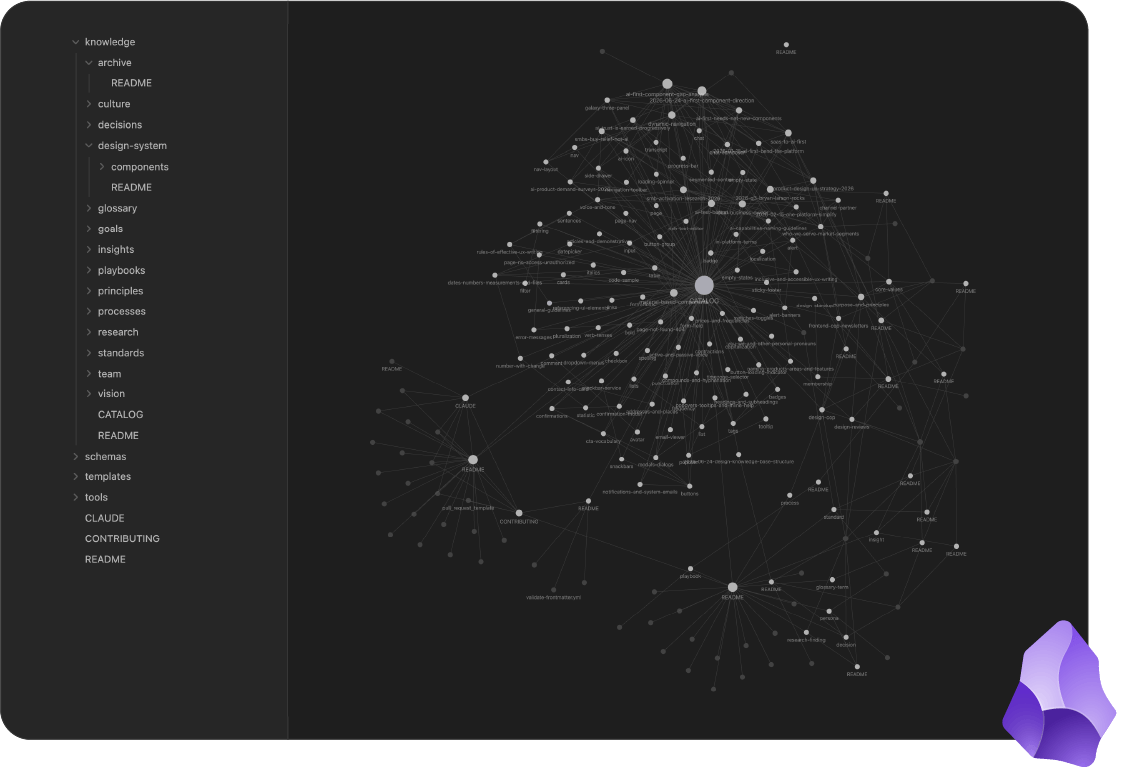
Before AI can reason about your business, your business needs a reliable source of organizational context. While the tools to manage this for your company continue to expand, I’ve found success with Github + Claude Code built around Google’s OKF (Open Knowledge Format) specification as a starting point for those with sufficient technical skill. It’s easier than you think to begin aggregating information if you have a documentation practice established, and every step you take will unlock new learnings. Here’s an early example of a doc-as-code knowledge tree built in Github and visualized in Obsidian for a Product Design org:
Capture Reasoning, Not Just Information
Once a knowledge foundation exists, teams naturally begin asking a different question: why?
Why did we pursue this market?
Why was one feature prioritized over another?
Why did we change direction?
One of the most common sources of friction inside growing companies is the loss of decision context. Teams revisit conversations that were settled months earlier. New leaders inherit initiatives without understanding the assumptions behind them. Product managers spend hours reconstructing why a particular trade-off was made. Decision logs are often made in silos, and rarely connect to the documentation they apply to.
Most companies are good at preserving information, but far fewer are good at preserving reasoning.
Capturing decisions transforms a repository of knowledge into a record of organizational thinking.
The old way: document information
What happened?
AI Lead Scoring launched in Q2.
Product & Design teams merged.
The new way: Document reasoning
Why did it happen?
We chose Lead Scoring because customer research showed higher ROI potential.
We merged Product and Design to reduce handoffs and improve customer outcomes.
Information tells us what happened, while reasoning explains how the organization thinks. Over time, this progression becomes increasingly valuable as the system starts to combine operational work, knowledge, decisions, principles, leading towards organizational memory. That distinction becomes increasingly valuable as both people and AI begin relying on organizational memory to make future decisions. Not just facts, but the reasoning behind them.
Continuously Engineer Organizational Context
Over the last few years, we've spent enormous effort learning prompt engineering, and in the next chapter we’ll watch the transformation towards context engineering as a key component of DocOps. The best AI systems won't simply retrieve documents, they'll assemble the right organizational context at the right moment. That doesn't mean employees suddenly become better documentarians. In fact it’ll be quite the opposite. Teams should continue working as they always have where meetings are recorded, pull requests are merged, research is completed, roadmaps evolve, etc. The difference is that those operational artifacts are continuously transformed into structured organizational knowledge:
Meeting transcripts become reusable insights.
Research becomes evidence.
Weekly updates become organizational history.
Decision records become institutional memory.
Knowledge evolves continuously instead of being recreated repeatedly.
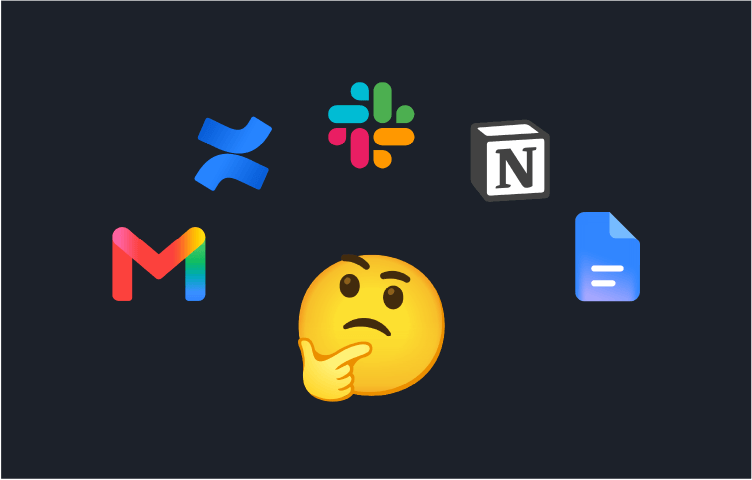
The old way: knowledge graveyard
Information is fragmented, outdated, and difficult to trust.
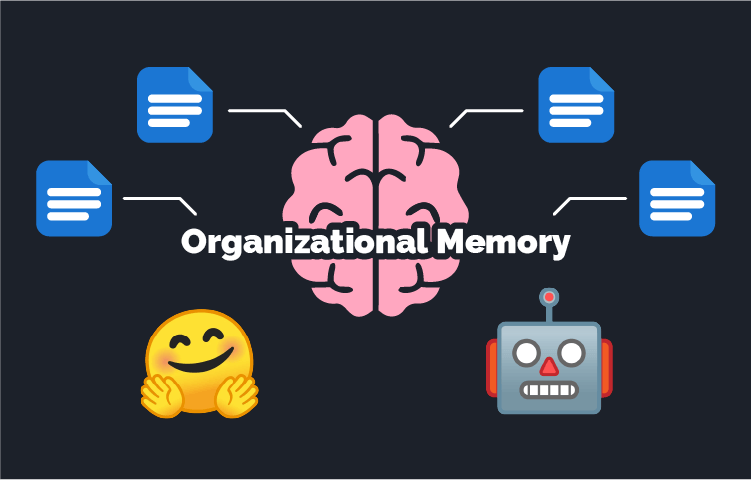
The new way: living organizational memory
Operational work continuously strengthens a shared context layer that both employees and AI systems can reason over.
An important principle here is truth proximity: keeping knowledge as close as possible to its source. Rather than repeatedly copying information between documents, presentations, and collaboration tools, organizational memory should remain connected to where the work actually happens. The fewer times context is copied, the less likely it is to become stale or distorted. Likewise, organizational memory shouldn't belong to a documentation team. Everyone who contributes to the work contributes to the organization's memory. AI helps transform those contributions into structured, connected knowledge. This shared-responsibility model reflects the idea that documentation is a byproduct of doing the work well, not a separate deliverable.
Increasing trust in organizational context leads to increased trust in AI.
The Strategic Opportunity
Throughout my career, I've watched technology companies invest heavily in systems of record. We built systems to manage customers, finances, projects, and operations because we understood that reliable information creates leverage. The next system of record isn't for transactions, it's for organizational context.
The companies that succeed won't necessarily have larger AI budgets or earlier access to new models. They'll have stronger context foundations, clearer records of how decisions were made, and organizational memory that becomes more valuable over time. DocOps is one approach to building that capability. More importantly, it represents a shift in how we think about knowledge itself. It’s not ideal as a collection of documents, but as a connected system that captures goals, decisions, principles, research, and operational history.
Companies that invest in organizational context will onboard faster, adapt faster, preserve institutional knowledge longer, and deploy AI more effectively. They'll spend less time rediscovering the past and more time building on it. In a world where access to intelligence is becoming increasingly commoditized, the competitive advantage may not be the models we use, it may be the quality of the internal business context those models are able to understand.